Category: japan
-

Traumatic dimensions of hikikomori: a Foucauldian note (TAJAN 2017, Asian Journal of Psychiatry)
Free access to my letter to the editor of the Asian Journal of Psychiatry. https://authors.elsevier.com/a/1UjO~_ggEwIEDM Clicks until May 05, 2017: free access to the article (No sign up or registration is needed) Highlights Acute social withdrawal (hikikomori) is an epidemic in Japan. There are three traumatic dimensions of hikikomori survivors: the trigger of bullying, the…
-
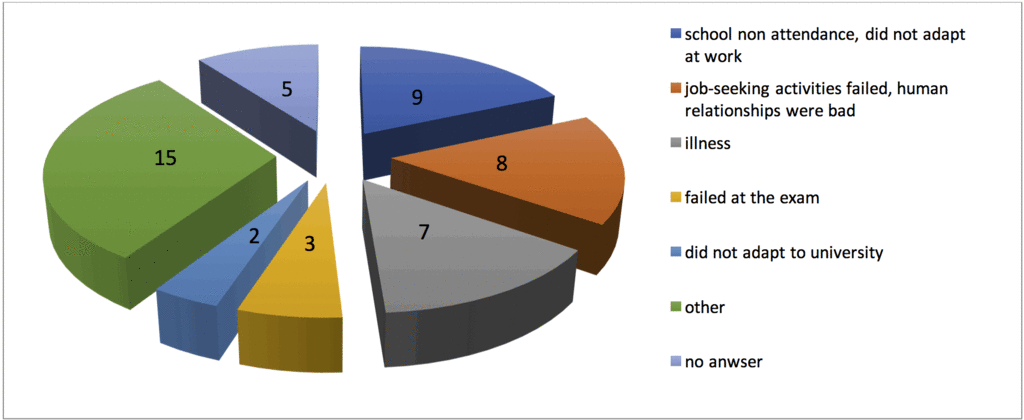
Hikikomori: The Japanese Cabinet Office’s 2016 Survey of Acute Social Withdrawal
Abstract In September 2016, the Cabinet Office of Japan published the results of an epidemiological survey focusing on acute social withdrawal (hikikomori). This article summarizes and assesses the major features of the survey. It aims at facilitating research and international exchanges on a mental health and social problem affecting at least 541,000 people in Japan…
-

マギル大学 「病の語り」のアンケート2017
マギル大学「病の語り」のアンケート Second Japanese version: Yasuo Miwaki & Nicolas Tajan, February 2017 Free to read & use PDF: https://www.mcgill.ca/tcpsych/research/cmhru/mini
-
Can “ Pokémon GO ” rescue shut-ins (hikikomori) from their isolated world?
Article by Kato et al. published online in December 2016 in Psychiatry and Clinical Neurosciences Open access: http://onlinelibrary.wiley.com/doi/10.1111/pcn.12481/full PS: “To date, there has been no evidence showing a correlation between the use of personal computers (PCs) and/or information technology (IT) and the occurrence of hikikomori, at least in Japan.”
-
Le Hikikomori entre Idiome culturel et expression actuelle de la souffrance au passage de l’adolescence à l’âge adulte (De Luca 2016)
L’Évolution Psychiatrique, Available online 26 July 2016, http://www.sciencedirect.com/science/article/pii/S0014385516301517 Abstract Aim Hikikomori is a syndrome involving withdrawal into the home for a duration of more than 6 months, identified among Japanese teenagers and young adults. The cultural and sociological approach is central in Japan, where a psychiatric understanding has long been denied. We set out to demonstrate…
-
Gatebox – virtual home robot
-
Hikikomori – le refuge /Joris Mathieu
-

フランスにおけるひきこもり当事者の「病の語り」
第23回多文化間精神医学会学術総会 2016 http://www.procomu.jp/jstp2016/ フランスにおけるひきこもり当事者の「病の語り」 タジャン・ニコラ 京都大学 人文科学研究所 「病いの語り。慢性の病いをめぐる臨床人類学」(The Illness Narratives. Suffering Healing and the Human Condition) の著者、アーサー・クラインマン。彼が1988年に発表した、この有名な本から、多くの 病の語りの研究が行われています。それに導かれた「マギル大学の病の語りのアンケート」(McGill Illness Narrative Interview-MINI) は重要な方法論的な貢献と考えられています。ダニエル・グロローとアラン・ ヤングとローレンス・J. カーマイヤーは2006年に英語バージョンを出版しました。また、ダニエルグロロー のフランス語バージョンは、2013年に出版されました。2014年8月に、三脇康生とタジャンニコラはMINI の最初の日本語バージョンを確定して、2016年8月に修正されたバージョンを出版しました1。 本発表の目的はMINIと文化的定式化面接 (CFI) と NVIVOデータ分析ソフトの関連性を論じることにあ ります。フランスに住んでいる女性 (20歳) のケースにフォーカスを当てています。この病の語りの調査は、 次のテーマを明らかにします。すなわち、このケースで問題となった、健康問題に関係する一連の出来事、 その典型 (プロトタイプ) の語り、語りに持ちられている説明モデル、治療サービスと治療への同意の語り、 生活への影響、文化の影響。総体的には、このケースを、定性手法を用いて、分析を行いたいと思います。 その結果、多文化間研究の枠組みの中でMINIとCFIとNVIVOの貢献と限界を議論します。 本発表は、病の経験とひきこもり当事者に興味を持ってすべての人々に開かれています:精神科医、臨床 心理士、看護師、ソーシャルワーカー、当事者等の方々のどなたでもお聞きいただきたいと思っています。 1以下のウェーブサイトでダウンロード可能:https://www.mcgill.ca/tcpsych/research/cmhru/mini 以下参照 第23回多文化間精神医学会学術総会 2016 10 月 1 日土 9:00 〜 10:30 座長:三脇 康生(仁愛大学人間学部 心理学科)…
-
Japanese Parents’ Narratives of Social Withdrawal
Emplotting Hikikomori: Japanese Parents’ Narratives of Social Withdrawal Article in Culture Medicine and Psychiatry · May 2016 DOI: 10.1007/s11013-016-9495-6 1st Ellen Rubinstein 11.8 · Rutgers Robert Wood Johnson Medical School, Somerset, New Jersey Abstract Hikikomori, often glossed as “social withdrawal,” emerged as a sociomedical condition among Japanese youth at the end of the twentieth century, and it continues to…
-
The Ecology of Withdrawal (Frontiers in Psychology)
General Commentary ARTICLE Front. Psychol., 23 May 2016 | http://dx.doi.org/10.3389/fpsyg.2016.00764 The Ecology of Withdrawal. Commentary: The NEET and Hikikomori spectrum: Assessing the risks and consequences of becoming culturally marginalized Michael E. W. Varnum* and Jung Y. Kwon http://journal.frontiersin.org/article/10.3389/fpsyg.2016.00764/full?utm_source=newsletter&utm_medium=email&utm_campaign=Psychology-w27-2016
 Nicolas Tajan